Quit Nicotine Pouches & Zyn
How to quit nicotine pouches & Zyn
Modern nicotine pouches are deceptively hard to quit — some Zyns carry as much nicotine as a cigarette, they're invisible to use, and the flavors make the habit pleasant. That's not a willpower problem; it's a design problem, and it's why “just use less” rarely works. What does work is a plan: see your real usage, choose cold turkey or a taper, ride out a withdrawal you know is coming, and get back on track fast after a slip.
This guide pulls together everything PouchBuddy has written on quitting — the step-by-step plan, exactly what Zyn withdrawal feels like and how long it lasts, the honest answers on whether pouches are bad for you, and the alternatives worth trying. Start with the plan below, then dig into whatever you need.
Pouch Buddy
Quitting works better when you can see it
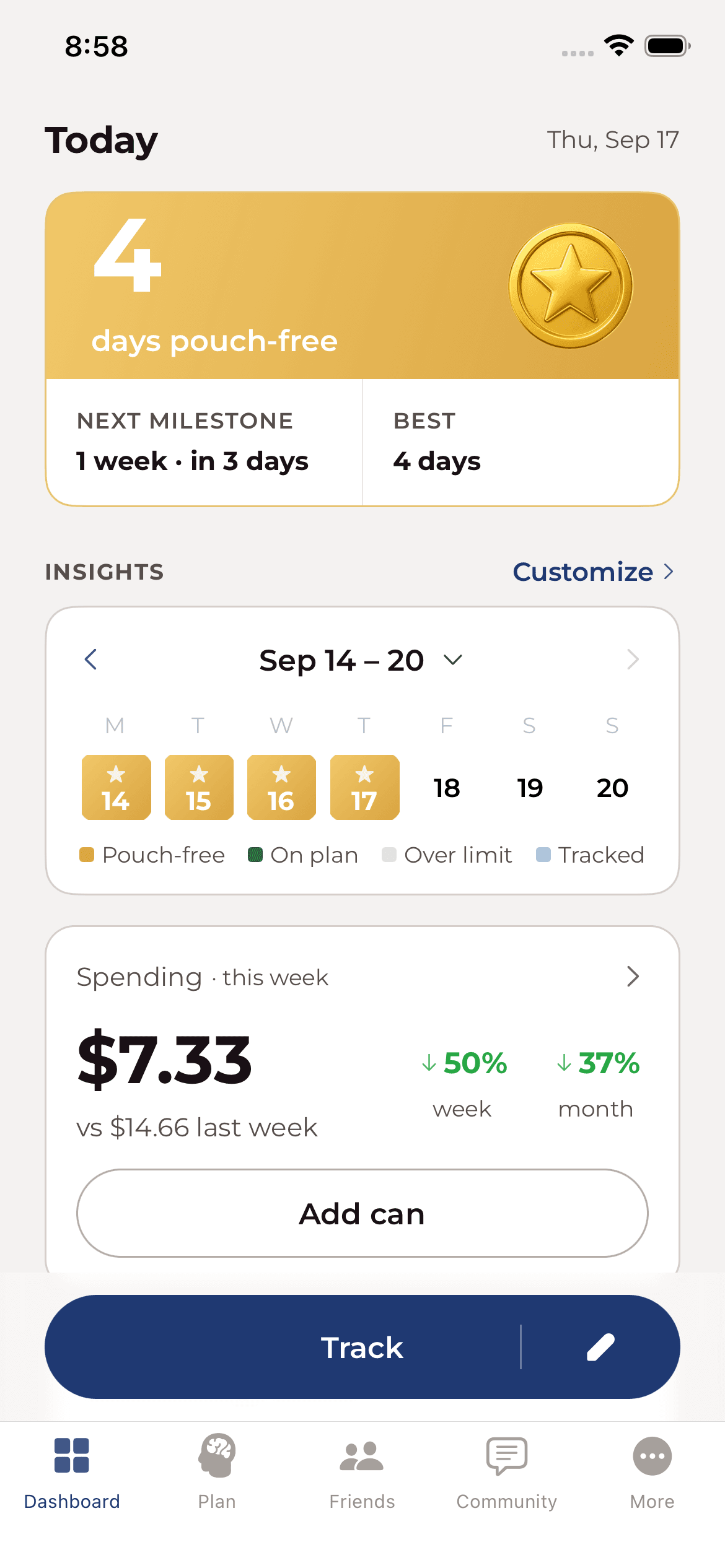
PouchBuddy logs every pouch by brand and strength, sets a daily limit, and charts your nicotine falling — so cutting back becomes something you can actually watch happen.
The step-by-step quit plan
Whether you stop cold turkey or taper down, the same loop works: see your real usage, pick a path, ride out the cravings, and get back on plan after a slip. Here it is step by step.
Step 1: Find out how much you actually use
Before you change anything, count. For three or four days, track every single pouch and don't try to cut back yet — most people are genuinely surprised by the number. You can't shrink what you can't see, and a real baseline is what makes the rest of the plan concrete. (It's the whole reason PouchBuddy exists — log each pouch by brand and strength and watch the daily count add up.)
Step 2: Choose cold turkey or taper
There are two honest paths, and neither is “better” — it's about what you'll actually stick to. Cold turkey means picking a quit date and stopping completely: fastest, but the withdrawal hits harder up front. A tapermeans setting a daily limit just below your baseline and lowering it each week (12 → 10 → 8 → 6 …): slower, but far more sustainable, and each week feels winnable. If you go through more than ~8–10 pouches a day, tapering usually sticks better.
Step 3: Set a quit date and a plan
Pick a specific date within the next two weeks — soon enough to keep momentum, far enough to prepare. Write down your step-down schedule (or your hard stop date) and tell at least one person. A plan you've committed to out loud is much harder to quietly abandon.
Step 4: Have a craving plan ready
Cravings are intense but short — most pass within 3–5 minutes whether or not you give in. When one hits, run the 4 Ds: delay (set a 5-minute timer before you let yourself have one), drink water, distract (move, text a friend), and deep breathe. Keep oral substitutes on hand too — gum, mints, toothpicks, sunflower seeds. More tactics: practical ways to beat nicotine cravings.
Step 5: Know what withdrawal feels like — day by day
Nicotine withdrawal is real, predictable, and temporary, and the hardest days are the early ones — the ones you can see coming:
- Day 1 — the automatic reach. Cravings start and you notice how often your hand goes for a pouch out of pure habit.
- Days 2–3 — the peak. Strongest cravings, irritability, restlessness, trouble concentrating, headaches. Get through here and the worst is behind you.
- Days 4–7 — the turn. Cravings get shorter and less frequent; mood and focus start to lift.
- Week 2 — the new normal. Physical symptoms mostly fade; cravings become situational rather than constant.
- Beyond.Occasional cravings surface for weeks, usually sparked by a routine or stress, but they're brief and beatable.
For the detailed version, see the Zyn withdrawal timeline. You might also notice physical effects like headaches, stomach and digestive changes, heartburn and acid reflux, diarrhea, brain fog, blood-pressure changes, poor sleep, and a bigger appetite — all normal and manageable. If it feels overwhelming, nicotine replacement therapy (patches, gum, lozenges) is FDA-approved to help — ask a doctor or pharmacist whether it's right for you.
Step 6: Remove the triggers
Most pouches aren't about nicotine cravings at all — they're attached to routines: your morning coffee, the drive to work, a screen, a drink. For your first couple of weeks, change the routine, not just the habit — take a different break, keep your hands busy, and avoid the situations most tied to pouching until the association fades.
Step 7: Don't do it alone
Accountability is one of the strongest predictors of quitting for good. Tell friends, quit alongside someone, or lean on a community doing the same thing. In the U.S. you can call the free quitline at 1-800-QUIT-NOW for coaching. PouchBuddy lets you add friends and quit together, so someone can actually see your progress.
Step 8: A slip is not a failure
Most people who quit for good do it after a few attempts — that's the normal path, not a sign it won't work. If you have a pouch after your quit date, it's one pouch, not square one. Note what triggered it and get back on plan the same day.
Pouch Buddy
Ready to set a quit date?
Log your last pouches and let PouchBuddy track the taper to zero — daily limits, streaks, and friends who keep you honest.
Frequently asked questions
How long does it take to quit nicotine pouches?
The hardest physical withdrawal lasts about two weeks, peaking on days 2–3, then easing steadily. Cravings tied to habits and stress can linger longer but get shorter and rarer. Most people who quit for good do it over a few attempts — that's normal, not failure.
Is it better to quit Zyn cold turkey or taper down?
Both work — it comes down to what you'll actually stick to. Cold turkey is fastest but the withdrawal is sharper up front; tapering is gentler and tends to suit heavier users (more than ~8–10 pouches a day), because each week's smaller limit feels winnable.
What helps most with cravings?
Riding out the 3–5 minutes a craving lasts — delay, water, distraction, deep breaths — plus oral substitutes like gum or mints, and removing the routine triggers tied to your habit.
Will I gain weight or feel foggy when I quit?
A bigger appetite and some brain fog are common, temporary withdrawal effects, not permanent. They typically ease within a couple of weeks as your body readjusts.
Tools to make it stick
The plan above is the method; these make it concrete — a Zyn tracker to log every pouch and watch the count fall, the mg ladder to step down by, and nicotine-free alternatives worth trying while you taper.
Zyn tracker
Log every pouch by brand and strength, see your real daily count and nicotine in mg, and set a limit that falls.
Zyn alternatives
12 nicotine-free pouches that keep the ritual without the nicotine — plus step-down and NRT routes off.
Best apps to quit nicotine pouches
The best apps to quit or cut back on nicotine pouches in 2026 — real pouch-specific trackers compared on features, ratings, and platform support.
Nicotine pouch strengths & stepping down by mg
What the mg on a can really means, which nicotine pouches are strongest, and how to step down from high-strength pouches to 1mg and zero.
Withdrawal & cravings: what to expect
Nicotine withdrawal is real, predictable, and temporary. Knowing the timeline — and having a craving plan — is most of the battle.
Zyn withdrawal symptoms & timeline
Zyn withdrawal symptoms day by day — when they peak, how long they last, whether to quit cold turkey or taper, and when the brain fog lifts.
Managing nicotine withdrawal symptoms
A practical guide to overcoming withdrawal symptoms with the right game plan, support network, and proven coping strategies.
How to beat nicotine cravings
Learn evidence-based strategies to overcome nicotine cravings: spot triggers, build coping skills, change your lifestyle, and find support.
Benefits of quitting Zyn
What actually improves when you quit Zyn — and when. The benefits of quitting nicotine pouches, hour by hour and week by week, from cravings to your heart.
How to avoid relapsing
Discover 8 evidence-based relapse prevention strategies to help you quit nicotine pouches for good. Build a solid plan for lasting success today.
Are nicotine pouches actually bad for you?
The honest, sourced answers on the health questions people ask before they quit — heart, cancer risk, gums, and what's really inside a pouch.
Are nicotine pouches bad for you?
What the FDA and health experts actually say about nicotine pouches like Zyn — the real risks to your heart, gums, and more, plus how to cut back.
Is Zyn bad for your heart?
Zyn has no smoke or tar — but the nicotine still puts real, measurable stress on your heart. Here's what the science says about pouches and cardiovascular health.
Does Zyn raise blood pressure?
Does Zyn raise blood pressure? What studies show about nicotine's effect on blood pressure and heart rate, how long it lasts, and what happens when you quit.
Does Zyn cause cancer?
There's no evidence Zyn causes cancer, and it lacks the tobacco leaf and smoke behind most tobacco cancers — but it's new, and lower risk isn't no risk.
What Zyn does to your gums
What a Zyn does to your gums: irritation, recession where you park it, why it can hide gum disease, whether gums recover, and if your dentist can tell.
Zyn with Invisalign
Not with the aligners in — and the bigger problem is the math. A 30-minute pouch eats a quarter of your daily tray-out time. What that costs your treatment.
What's actually in Zyn?
Zyn has no tobacco leaf — just nicotine, plant fillers, pH adjusters, sweeteners, and flavoring. Here's every ingredient and what each one does.
Zyn side effects
The physical effects pouch users actually search for — what causes them, and what eases them.
Why Zyn upsets your stomach
Yes — Zyn makes you poop. Why nicotine pouches cause diarrhea, stomach pain, heartburn and bloating, what the transit-time studies show, and what actually helps.
Zyn heartburn & acid reflux
Why Zyn and nicotine pouches trigger heartburn and acid reflux — the sphincter mechanism backed by studies, plus what actually eases it.
Can you swallow Zyn spit?
Can you swallow the spit from a Zyn pouch? What the nicotine-laced saliva does, whether it's harmful, and why it causes the hiccups, nausea, and gut effects.
Why nicotine pouches cause headaches
Yes — Zyn and nicotine pouches can cause headaches, both from too much nicotine and from withdrawal. Here's why your head hurts and how to make it stop.
Zyn brain fog & anxiety
Zyn can cause brain fog and anxiety — both while you use it and when you quit. Here's why nicotine clouds your focus and mood, and how long the fog lasts.
Know your habit
How much is too much, how long a pouch really works, and how Zyn stacks up against other nicotine — the context that makes cutting back easier.
How many Zyns a day is too much?
Ten 3mg Zyns is 30mg of nicotine a day — more than many smokers get. Where the line really is, the red flags you're past it, and how to cut back.
How long does a Zyn last?
A Zyn lasts about 20–40 minutes in your mouth, with most nicotine released in the first 15–30. Here's the full timeline — in your mouth and in your system.
How long Zyn stays in your system
How long Zyn and nicotine stay in your system — blood, urine, and saliva detection windows, the cotinine half-life, and what actually clears it.
What happens if you swallow Zyn?
Swallowing your spit is normal. Swallowing the pouch itself usually just upsets your stomach — but for a child or pet, even one Zyn is an emergency.
Zyn vs vaping: which is worse?
Both skip the smoke, neither is safe. The real difference: vaping hits your lungs, pouches stay in your mouth. Here's the honest comparison.
Zyn Ultra strength explained
Zyn Ultra explained: 9 mg and 11 mg strengths, all 8 flavors, the June 2026 US launch — and what a stronger pouch means for your daily nicotine.
ALP vs Zyn compared
ALP vs Zyn compared: strengths, flavors, moist vs dry, who owns each brand and where they're made — plus the one number that actually matters.
Pouch Buddy
Quit nicotine pouches for good
Pick your path above, then make it stick with PouchBuddy — track every pouch, watch your nicotine fall, and quit alongside friends.
This guide is general information, not medical advice. Talk to a doctor or pharmacist about quitting options that fit your health, including whether nicotine replacement therapy is right for you. In the U.S. you can call the free quitline at 1-800-QUIT-NOW.