Health · June 29, 2026
Do Zyns Make You Poop? Zyn, Diarrhea & Stomach Issues
Yes — Zyn makes you poop. Why nicotine pouches cause diarrhea, stomach pain, heartburn and bloating, what the transit-time studies show, and what actually helps.

Short answer: yes, Zyn can absolutely make you poop — and it's not in your head. Nicotine is a stimulant, and one of the things it stimulates is your gut. The same chemistry behind that effect also explains the heartburn, bloating, and acid reflux a lot of pouch users notice. Here's what's actually going on, symptom by symptom.
Do Zyns make you poop?
For many people, yes — often within minutes. Nicotine activates the enteric nervous system (the network of nerves lining your gut) and speeds up colonic motility — the muscle contractions that move things through your intestines. It's the same reason a morning coffee sends people to the bathroom. A fresh pouch delivers a quick hit of nicotine, your colon gets the signal, and things start moving.
If you've noticed you reach for a Zyn and then need a bathroom soon after, that's a real, well-understood effect — not a coincidence.
Why do Zyns make you poop? What the studies show
The gut-speeding effect of nicotine is well-documented:
- In healthy non-smokers, nicotine cut rectosigmoid transit time from 18.6 hours down to 7.1 hours — waste moving through in roughly a third of the usual time (colonic motility study, PubMed). Faster transit means less time to absorb water, and looser stool.
- Nicotine stimulates nicotinic acetylcholine receptors in the gut, triggering stronger colonic contractions and increased mucus secretion — both of which reduce transit time and soften stool. It's the same pathway that makes coffee-and-nicotine a reliable morning routine for so many people.
- Higher doses produce high-amplitude propagating contractions — the powerful "clear-out" waves your colon uses — which is why a strong pouch on an empty stomach can hit hardest.
The pattern most users notice fits the science exactly: more nicotine, and a stronger pouch, means a stronger gut reaction. It's dose-dependent.
Pouch Buddy
Stepping down from 6 mg to 3 mg?
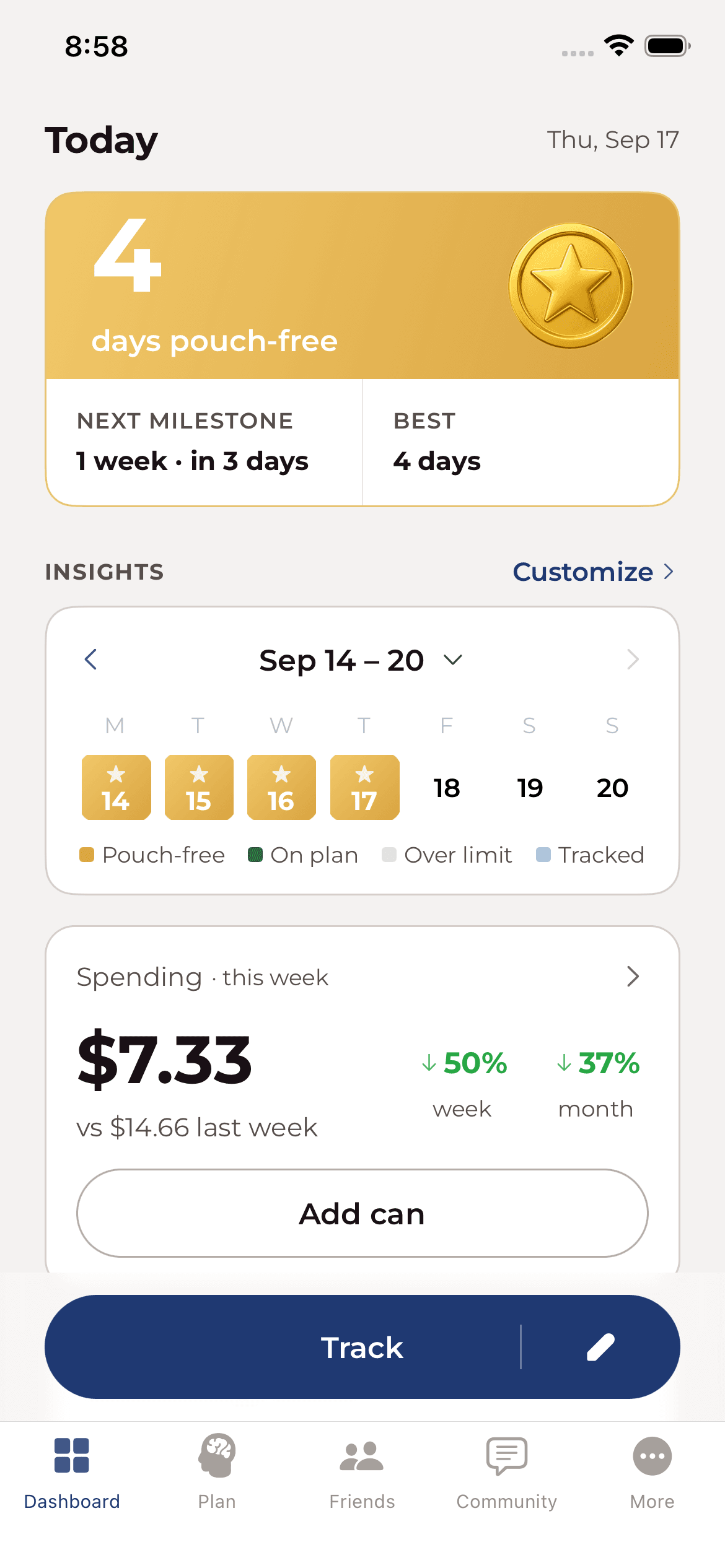
PouchBuddy tracks nicotine in mg, not just pouch count — so you can step down at a pace you choose.
Can Zyn or nicotine pouches cause diarrhea?
Yes. When nicotine pushes gut motility too hard, food moves through faster than your intestines can absorb water from it — which shows up as loose stools or diarrhea. Higher-strength pouches and using them on an empty stomach tend to make this worse. Some people also feel cramping or a dull stomach ache as the gut works overtime, especially early in the day or when they bump up their strength.
Why a pouch can hit harder than a cigarette
With a pouch you swallow a steady stream of nicotine-laced saliva for 20–40 minutes — a slow, continuous dose delivered right into the digestive tract. On an empty stomach, first thing in the morning, that's a recipe for urgency.
Zyn, heartburn and acid reflux
This one trips people up because it feels unrelated to "a thing under your lip." Two mechanisms are at play:
- Nicotine relaxes the lower esophageal sphincter — the valve that's supposed to keep stomach acid down. When it loosens, acid creeps up, and you get that burning heartburn feeling.
- You swallow more saliva. Pouches make you salivate, and constantly swallowing alkaline, nicotine-laced saliva can irritate the stomach lining for some people. (Swallowed a whole pouch by accident? Here's what happens if you swallow a Zyn.)
If you regularly get heartburn or acid reflux after pouching, the pouch is a likely trigger.
Bloating, burping and gas
The extra swallowing that comes with a pouch means you also swallow air — which comes back as burping, bloating, or gas. Add a stirred-up, faster-moving gut and a bloated, gassy feeling is common. It's uncomfortable but generally harmless.
The flip side: constipation when you quit
Here's the twist that surprises people who are quitting: when you stop, the gut stimulation stops too, and your digestion can briefly slow down. Temporary constipation is a recognized part of nicotine withdrawal — your gut has been getting an artificial nudge for a long time and needs a week or two to recalibrate. It passes. (More on the full arc in the Zyn withdrawal timeline.)
What actually helps
- Use on a full stomach, not an empty one — it blunts the motility spike.
- Drop your strength. A lot of gut symptoms scale with the nicotine dose; a 6 mg → 3 mg step often calms things noticeably.
- Don't swallow the saliva you can help — it cuts both the reflux and the gas.
- Hydrate, especially if you're getting loose stools.
- The real fix is less nicotine. Most of these symptoms fade as you cut back, and disappear when you stop. If your gut is the thing finally pushing you to quit, that's a good reason — here's how to quit Zyn.
Pouch Buddy
Stepping down from 6 mg to 3 mg?
PouchBuddy tracks nicotine in mg, not just pouch count — so you can step down at a pace you choose.
When to see a doctor
Occasional gut upset from pouches is common, but see a doctor if you have severe or persistent stomach pain, blood in your stool, black stools, ongoing diarrhea, or heartburn frequent enough that you're reaching for antacids most days. Those aren't "just the Zyn" and deserve a real look.
The bottom line
Zyn makes you poop because nicotine speeds up your gut — it's measurable in transit-time studies, it scales with your dose, and that same stimulant effect drives the diarrhea, heartburn, reflux, bloating, and (when you quit) the brief constipation. None of it is dangerous for most people, and all of it eases as you lower the dose, which means using less is the direct fix. For a deeper look at one symptom, here's Zyn heartburn and acid reflux. If the side effects are adding up, see what's actually in a Zyn pouch and whether nicotine pouches are bad for you.
This article is general information, not medical advice. Talk to a doctor about persistent digestive symptoms or your nicotine use.
Sources
- PubMed — Colonic motility and the effects of nicotine on colonic motility
- GoodRx — Nicotine and digestion: does nicotine make you poop?
- FDA — FDA Authorizes Marketing of 20 ZYN Nicotine Pouch Products
- Mayo Clinic — Nicotine dependence
- Scientific Reports — Nicotine delivery and acute effects after use of tobacco-free nicotine pouches