Quitting · July 28, 2026
Nicotine Pouch Strengths: Step Down by mg
What the mg on a can really means, which nicotine pouches are strongest, and how to step down from high-strength pouches to 1mg and zero.

If you're trying to cut back, the number on the front of the can matters more than the number of cans. Six 3 mg pouches and three 6 mg pouches are the same nicotine — but only one of those looks like progress if you're counting pouches.
This is a guide to what pouch strengths actually mean, which pouches are the strongest, and how to use the mg number as a ladder down instead of a thing you ignore.
The short version
- The mg on the can is nicotine per pouch, not how much you absorb.
- Common US strengths run 2–8 mg. Zyn sells 3 mg and 6 mg.
- The strongest nicotine pouches on the wider market run far higher — some imported brands are 20 mg+ per pouch, several times a Zyn.
- 1 mg and 2 mg pouches exist, and they're the most useful rung on the way down.
- To taper, lower mg per day — not pouch count. Dropping strength while quietly using more pouches is the single most common way a step-down stalls.
What the mg number actually means
The strength printed on a can is the total nicotine loaded into each pouch. It is not the amount that reaches your bloodstream.
How much you actually absorb depends on how long you keep it in, where you park it, your own saliva and gum chemistry, and whether you swallow. A 6 mg pouch used for ten minutes may deliver less nicotine than a 3 mg pouch left in for an hour. That's why "how many do you use" is only half the picture — and why how long a Zyn actually lasts matters as much as the strength.
For tracking purposes, though, the label is the number you have. It's consistent, it's on every can, and if you use pouches roughly the same way each time, total mg per day is a genuinely good proxy for your intake trend.
Typical nicotine pouch strengths
Strengths shift as brands reformulate and new lines launch, so treat this as the shape of the market rather than a spec sheet — always check the can you're holding.
| Tier | Roughly | Where you'll see it |
|---|---|---|
| Very low | 1–2 mg | Step-down lines, "starter" strengths |
| Low | 3–4 mg | Zyn 3 mg, On! 2/4 mg, Velo lower tiers |
| Medium | 6–8 mg | Zyn 6 mg, Rogue 6 mg, On! 8 mg |
| High | 9–15 mg | Fre, Lucy's upper tiers |
| Very high | 16 mg+ | Imported/European brands — White Fox, Pablo, Killa, Siberia |
For context: a cigarette contains roughly 10–12 mg of nicotine, of which a smoker typically absorbs 1–2 mg. So a single 6 mg pouch holds several cigarettes' worth of delivered nicotine — which is exactly why pouches can build a heavier habit than people expect, and why "it's just a pouch" is misleading.
Pouch Buddy
Ready to take back control?
Track every pouch, set a daily limit, and cut back with friends.
The strongest nicotine pouches — and why chasing them backfires
People search for the strongest nicotine pouches or the highest mg nicotine pouch for two very different reasons: tolerance has crept up and the usual can doesn't do much any more, or they want fewer pouches for the same effect.
The second one sounds reasonable and almost never plays out. Here's the trap:
- You move up in strength to cut your pouch count.
- Your tolerance adjusts to the higher dose within days to weeks.
- Your pouch count creeps back to where it was — now at double the mg.
You end up with the same habit at a much higher nicotine load, and a harder withdrawal waiting whenever you do decide to stop. If you already track your use, this shows up unmistakably: pouch count flat, daily mg way up.
There's a second cost. Higher-strength pouches are harsher on the gums and more likely to bring on the physical stuff — headaches, stomach and gut issues, a racing heart. If you've moved up recently and started feeling rough, the strength is the first thing to look at.
If you're using the strongest pouches you can find and still not getting much from them, that's tolerance, not a weak product. The fix that works is going down, not up — and the first few days are the worst of it.
How to step down by mg
The ladder is simple. What makes it work is that each rung is small enough to be survivable and you can see yourself descending it.
Step 1 — Get your real baseline in mg. For three or four days, log every pouch and its strength, and change nothing. Multiply out: eight 6 mg pouches is 48 mg a day. Most people are surprised, and the surprise is useful — you can't shrink what you can't see. (PouchBuddy does this maths for you, but paper works too.)
Step 2 — Cut about 20–25% of your daily mg, not your pouch count. From 48 mg, aim for roughly 36 mg. You can get there by using fewer pouches, dropping to a lower strength, or both. Letting people choose how to hit the number is why mg targets stick better than pouch limits.
Step 3 — Hold each rung for about a week. Long enough for your body to settle, short enough to keep momentum. If a week feels brutal, hold two — a slower ladder you finish beats a fast one you abandon.
Step 4 — Use strength changes for the big drops. Going 6 mg → 3 mg halves your intake in one move without changing your routine at all. That's usually far easier than cutting your pouch count in half, because the ritual — the number of times a day you reach for one — stays intact. This is the single most under-used lever in a taper.
Step 5 — Land on 1–2 mg, then decide. The bottom rungs matter. From 1 mg, stopping entirely is a small step rather than a cliff. Some people go from there to nicotine-free pouches to keep the ritual while dropping the drug; others just stop.
A worked example, starting at eight 6 mg pouches a day:
| Week | Plan | Daily mg |
|---|---|---|
| 1 | Baseline — 8 × 6 mg | 48 mg |
| 2 | 6 × 6 mg | 36 mg |
| 3 | 8 × 3 mg | 24 mg |
| 4 | 6 × 3 mg | 18 mg |
| 5 | 4 × 3 mg | 12 mg |
| 6 | 6 × 1 mg (or 3 × 2 mg) | 6 mg |
| 7 | 2 × 1 mg, then nicotine-free | 2 mg → 0 |
Seven weeks, no week asking more than about a quarter off the last. Adjust the pace to your life — the shape is what matters.
Let the plan do the ladder for you
That table is the manual version. It's also, more or less, exactly what PouchBuddy's step-down plan builds for you — which is worth knowing before you go and maintain a spreadsheet.
You give it two numbers: where you are now and where you want to end up (usually zero). Then you pick how you want to get there:
- Set a target date. The plan draws a smooth curve between the two, taking a constant percentage off as it goes — bigger cuts early, gentler ones near the bottom where each pouch is hardest to give up. This is the same logic as the "take about a quarter off each week" rule, just calculated for your actual numbers and your actual deadline.
- Set your own pace. If you'd rather think in plain steps, tell it to cut a fixed amount every so many days — "one fewer pouch every three days" — and it holds each level flat, then drops. No curve, no maths, just the next rung.
Two things make it work better than a note on your phone:
- You can run the whole plan in mg instead of pouches. This is the part that matters for everything above — set the plan in milligrams and dropping from 6 mg to 3 mg registers as the 50% cut it actually is, instead of showing up as no progress at all. A pouch-count plan can't see strength changes; an mg plan is built on them.
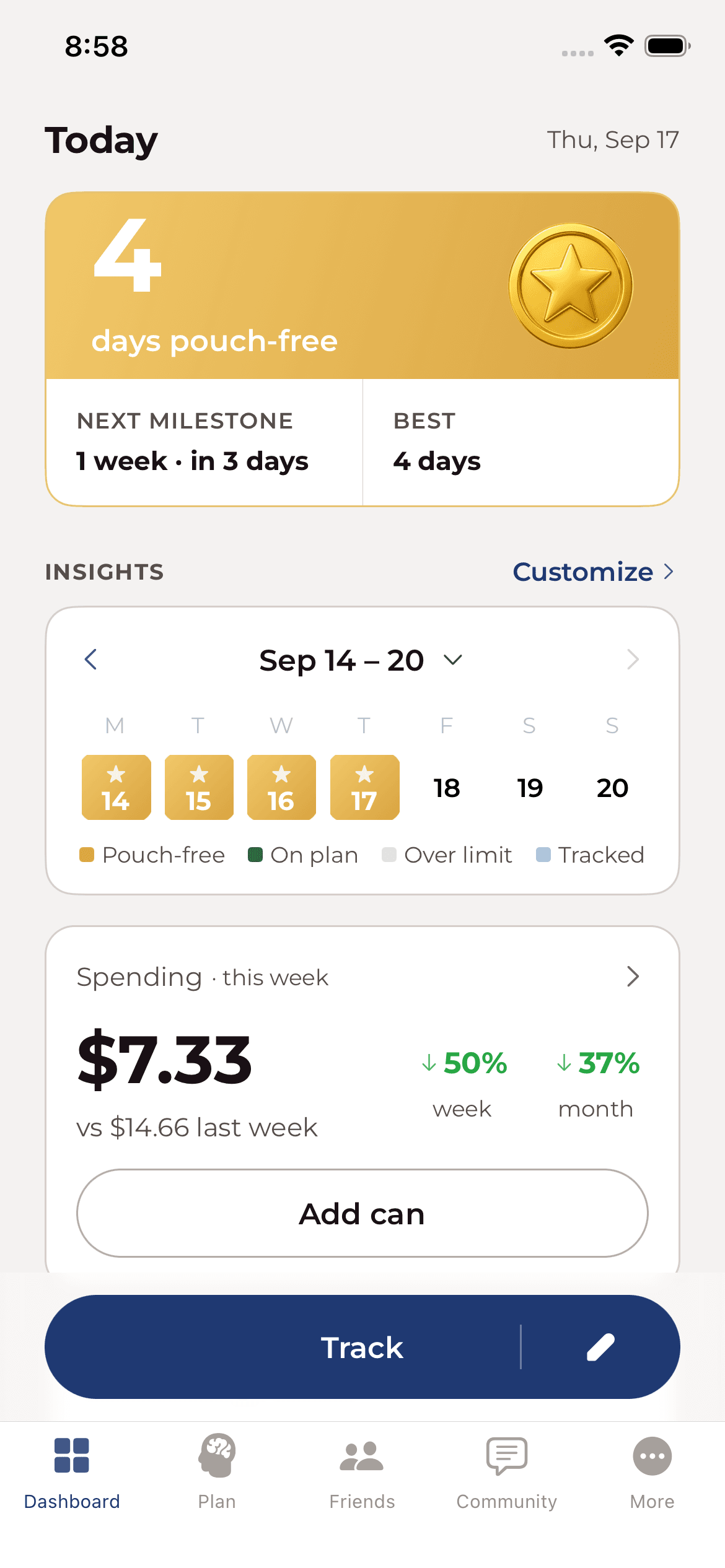
- Every day gets a specific number. Your limit for today sits on the dashboard next to what you've actually logged, and days you finish under it build a streak. That's the difference between a plan you're following and a plan you wrote down once.
You can change the target or the pace whenever you like — a ladder you adjust is still a ladder, and it beats abandoning one that turned out to be too steep.
Pouch Buddy
Ready to take back control?
Track every pouch, set a daily limit, and cut back with friends.
Why mg is the better metric
Pouch count is the number everyone reaches for, and it's the one that lies to you.
- It hides strength changes. Cutting from ten pouches to six looks like a 40% win. If you also moved from 3 mg to 6 mg, your nicotine went up by 20%.
- It punishes the easiest win. Halving your strength is often the least painful change available — and a pouch counter records it as no progress at all, which is a great way to talk yourself out of it.
- It's the number withdrawal actually tracks. How rough quitting feels follows your nicotine load, not how many times a day you reached for a can.
Count both, but make the mg line the one you're steering by. That's why PouchBuddy totals milligrams alongside pouch count, and why its plans can be set in either — see how many Zyns a day is too much for what a normal range even looks like.
Common mistakes when stepping down
- Dropping strength and using more. The classic. Watch daily mg, not the can.
- Cutting too fast. A 50% drop in week one usually ends in a rebound. 20–25% a week is boring and it works.
- Keeping the strong cans "for emergencies". They become the emergency. Finish them or bin them before you drop a rung.
- Not tracking the bottom rungs. People get to 2–3 pouches a day, stop counting, and drift back up over a month without noticing.
- Treating a slip as the end. One pouch above your limit is one pouch, not square one. Log it and carry on — most people who quit for good do it across a few attempts.
The bottom line
The mg on the can is the lever most people never pull. Cutting strength is often easier than cutting count, it halves your intake in one move, and it leaves the routine you're attached to untouched while the nicotine quietly drains out of it.
Get your baseline in milligrams, take about a quarter off each week, and use strength drops for the big steps. If you want the whole approach in order, here's how to quit nicotine pouches step by step — and if the plan is to stop entirely, what withdrawal actually feels like is worth reading before you start.
This article is general information, not medical advice. Talk to a doctor or pharmacist about quitting options that fit your health, including whether nicotine replacement therapy is right for you.
Sources
- FDA — Want to Quit Smoking? FDA-Approved and Cleared Cessation Products Can Help
- National Cancer Institute — Harms of Cigarette Smoking and Health Benefits of Quitting